Evidenza
Design Engineer for an AI market research platform: frontend design and development, backend collaboration, research-data troubleshooting with mathematicians, and a server-side export engine that pipes live data into Fortune 10–ready PPTX and Google Slides reports.
Evidenza is a synthetic AI market research platform for teams that need answers from hard-to-reach audiences. Instead of waiting months for traditional studies with low response rates, marketers and insights teams survey AI-generated customer panels — synthetic samples with unique personal and professional details — to explore demand, messaging, segmentation, and creative, often in hours rather than quarters.
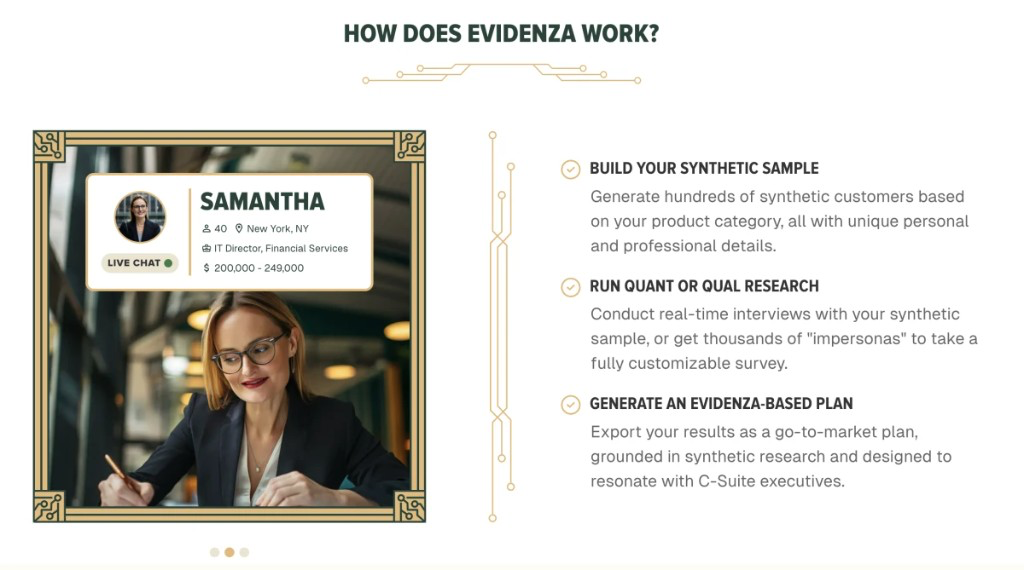
The product flow is three steps: build a synthetic sample for a category, run quantitative surveys or qualitative interviews with those impersonas, then export an evidence-backed go-to-market plan designed for C-suite audiences. Modules cover segmentation, positioning, creative testing, personas, brand measurement, and custom research — alone or combined into a full planning engine.
My role spanned the stack. I learned the backend deeply enough to design and ship the frontend, then worked with mathematicians and researchers to troubleshoot research data — fixing issues in both frontend and backend code when evals or sample results looked wrong. I also designed the final deliverable layouts for Fortune 10 clients and built a server-side export engine that plugs database data into templated PPTX and Google Slides decks.
How Evidenza works
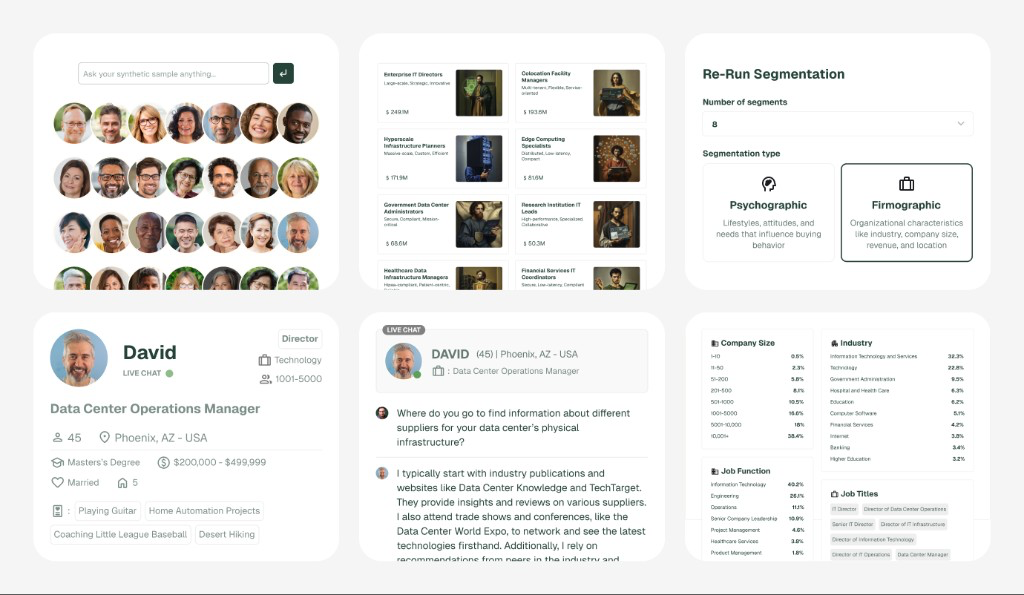
The core loop is simple to explain and hard to build well: generate hundreds of synthetic customers for a product category, interview them or run customizable surveys at scale, then export results as a go-to-market plan grounded in that research. Personas carry rich detail — role, demographics, income, household, interests — so answers feel specific rather than generic AI prose.
Synthetic personas
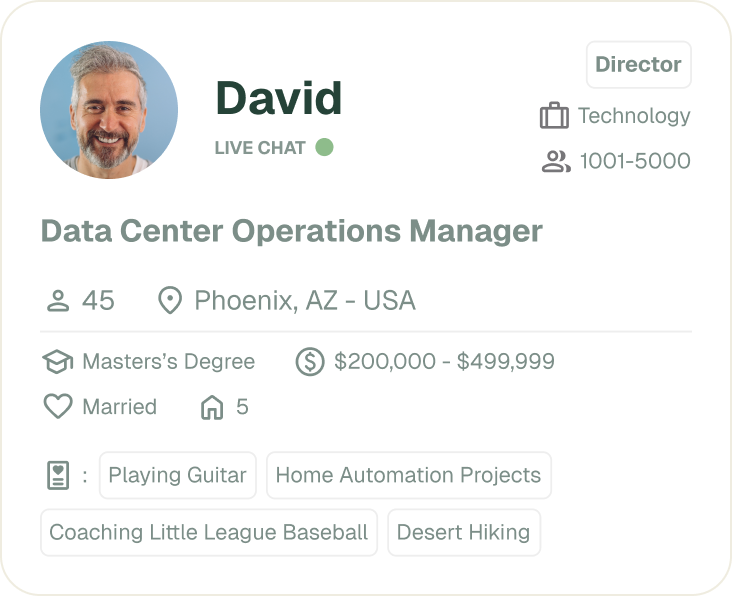
Each generated persona is a full profile: title and seniority, industry and company size, age and location, education and income, household context, and interest tags. Live-chat availability signals that the impersona can be interviewed in real time. I designed and implemented these surfaces so researchers can scan a person at a glance before going deeper.
Asking the synthetic sample
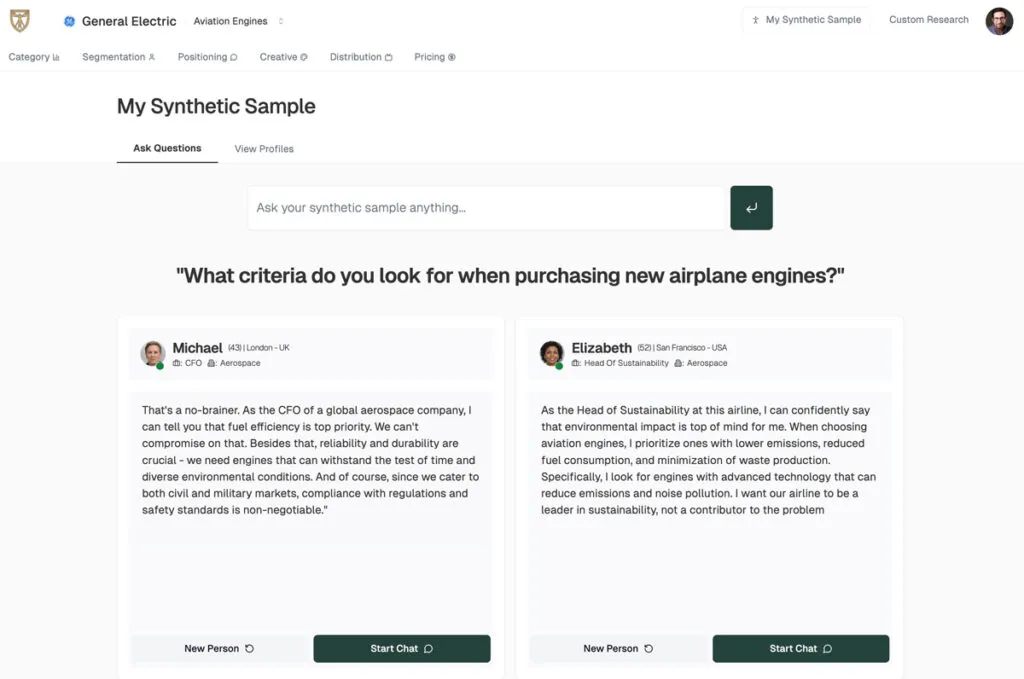
From My Synthetic Sample, teams ask one question and see parallel answers from different personas — for example a CFO prioritizing fuel efficiency versus a Head of Sustainability prioritizing emissions. Actions like New Person and Start Chat let researchers resample or drill into a one-on-one interview. I owned the UI for this ask-and-compare flow across research modules (category, segmentation, positioning, creative, and more).
Segmentation and market exploration
Beyond single personas, the product supports market segmentation — psychographic or firmographic, configurable segment counts, named segments with market size, a full synthetic sample grid, live chat into individuals, and aggregate firmographics (company size, industry, job function, titles). I designed and built the interfaces that make that exploration coherent: configure, scan segments, open a person, and read the stats that describe the sample as a whole.
Accuracy evals and aggregates of aggregates
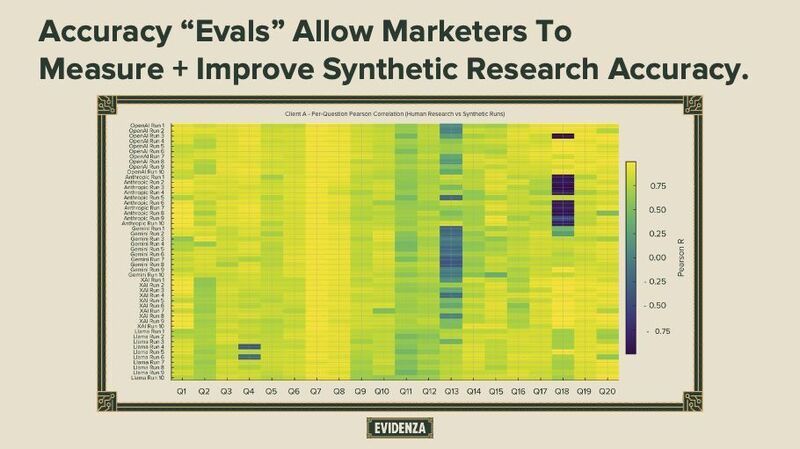
Trust matters as much as speed. Mathematicians on the team computed per-question Pearson correlations between human research and synthetic runs across model providers (OpenAI, Anthropic, Gemini, XAI, Llama) and many iterations. The heatmaps show where models agree with human benchmarks — and where individual runs or questions diverge. Reports are not a single model’s answer; they come from aggregates of aggregates. I partnered with researchers to interpret those evals, then fixed frontend and backend issues when the product or pipeline needed to change.
Report design and export engine
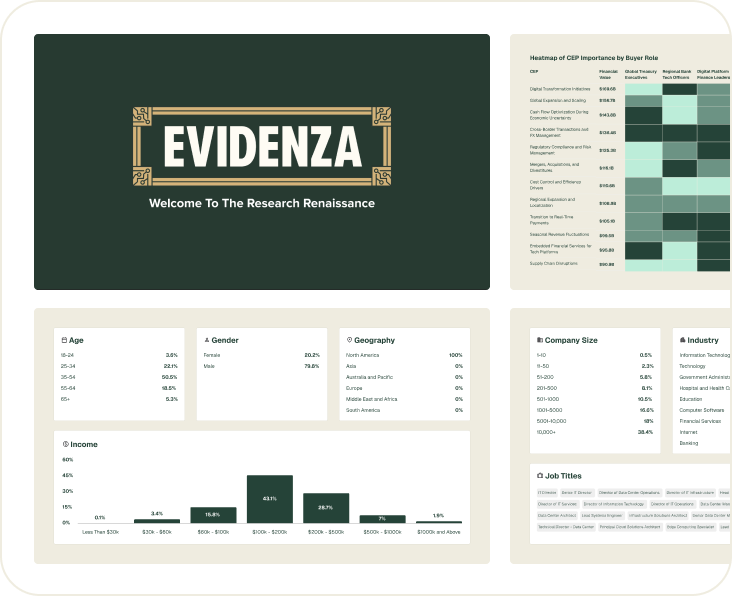
The final step is a client-ready research report. I designed report layouts in Figma and Illustrator — demographics, firmographics, CEP importance heatmaps, job titles, and more — then built a server-side TypeScript export engine that pipes live database data into templated PPTX and Google Slides. The draft below shows the kind of complex data I had to work with — it is not a reflection of the final deliverable. Production decks for Fortune 10 clients are more elaborate and available through Evidenza’s services.